
 by
by 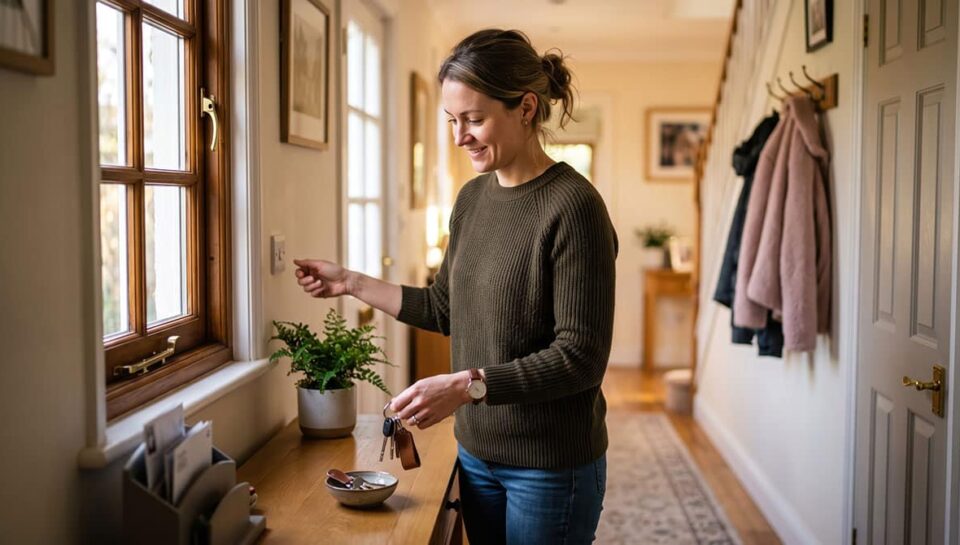
10 simple ways to create an ADHD-friendly home (because remembering where you put your keys was never the real problem!)
If you’ve got ADHD, you’ve probably heard some version of, “Just put things away.”
But where exactly is “away”?
If you’re anything like many of our clients across Doncaster, Leeds, Bradford, Wakefield, Huddersfield and Morley, “away” is wherever you happened to be standing when your attention wandered off to something far more interesting!
Here’s the thing though – it’s not a lack of effort. ADHD brains simply work differently. Instead of expecting yourself to remember where everything lives, your home should do some of the remembering for you.
I’ve written this blog as 10 clear points because I know many ADHD brains find shorter sections much easier to read than one long wall of text.
- Stop trusting your memory
Your brain has far more important things to think about than where the spare batteries live.
Create a home where you can see what you own rather than trying to remember it.
One client told us:
“I genuinely thought I didn’t own any scissors. Turns out I had eight pairs.”
I’ve heard worse!
- Keep things where you actually use them
This is one of the biggest changes we make in clients’ homes.
Medication by the kettle because that’s where your morning starts.
Charging cables where you actually sit.
Cleaning products where you use them.
Not where someone on Pinterest or Instagram thinks they should live.
- If you can’t see it… it probably doesn’t exist
Out of sight really can mean out of mind.
That doesn’t mean your home has to look like a supermarket shelf, but clear containers, open baskets and sensible labelling can make life so much easier.
A client recently laughed and said:
“Apparently I own three bottles of soy sauce. They’d all been hiding behind each other.”
- Labels are not cheating
Some people think labels are only for pantries worthy of Instagram.
I disagree.
Labels reduce decision-making, remove guesswork and help everyone in the household know where things belong.
Think of them as little reminders rather than instructions.
- Make putting things away easier than leaving them out
If you have to walk upstairs, open three cupboard doors and move two boxes to put something away…
…it’s probably staying on the kitchen worktop.
Your systems should work with your brain, not against it.
- Storage shouldn’t be a game of Tetris
Buying more storage rarely solves the problem.
The best storage is the storage that makes sense.
Sometimes that’s a basket.
Sometimes it’s a drawer divider.
Sometimes it’s simply owning fewer things.
Storage should support your belongings, not hide them.
- Create homes, not hiding places
Everything deserves an obvious home.
If an item keeps appearing in the same random spot, perhaps that’s where its home should actually be.
Your home should adapt to your life – not the other way around.
- Build habits around your routines
Forget trying to become “more organised.”
Instead, make organisation part of something you already do.
Keys go in the tray when you shut the front door.
Medication goes next to the coffee mugs.
Post gets opened beside the recycling.
Small habits win over big intentions every time.
- Perfection is overrated
Your home doesn’t need to look like a magazine.
It needs to work on a Tuesday morning when you’re running late and wondering where you’ve left your phone… while you’re holding it.
(We’ve all done it!)
As one client told us:
“I finally stopped trying to organise my home like everyone else’s and started organising it for me.”
Exactly.
- Ask for help
Sometimes all you need is another pair of eyes.
At A Tidy Mind Yorkshire, we don’t arrive with judgement or unrealistic expectations.
We work compassionately and at your pace to create organising systems that suit your lifestyle and your brain.
Wherever you are in Yorkshire or the surrounding areas, we’d love to help you create a home that’s easier to live in and much easier to maintain.
Need advice on storage solutions, labelling, or creating ADHD-friendly organising systems?
Get in touch for a friendly chat. We’d be delighted to help you find practical solutions that work for you – not against you.