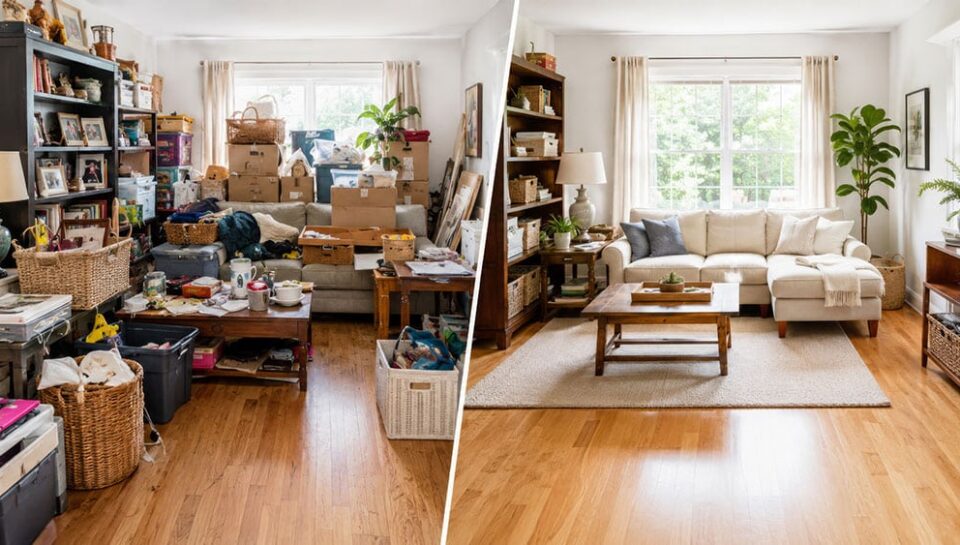
What we’ve learnt from helping over 350 clients create calmer, more manageable homes
If your home feels cluttered, you’re certainly not alone.
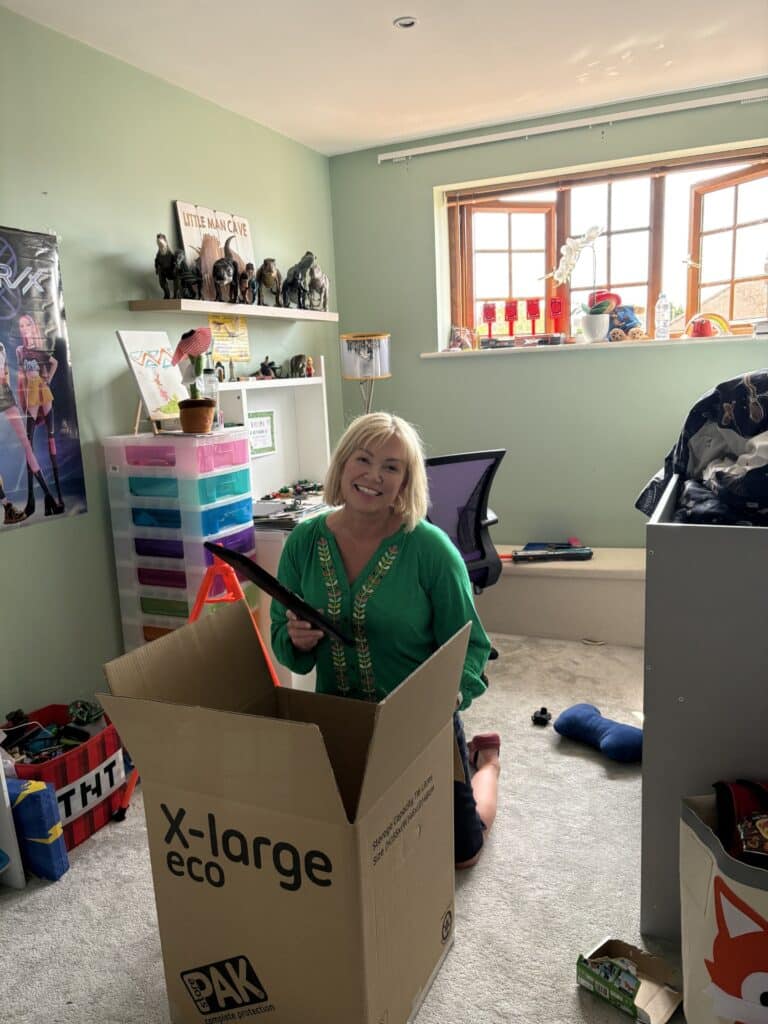
Over the last seven years, we’ve supported more than 350 clients with decluttering and home organisation, both in person and virtually. We’ve worked with people who feel completely overwhelmed by their homes, people who don’t know where to start, families whose homes have gradually become harder to manage, and lots of people with ADHD who find traditional organising advice simply doesn’t work for them.
And one thing we’ve learnt?
Decluttering isn’t really about having less stuff. It’s about making day to day life easier.
It’s about being able to find what you need, having less visual noise, making your home work for you and feeling more comfortable in your own space.
There isn’t one perfect way to declutter or organise your home. What works for one person might be completely wrong for another.
But over the years, these are the tips we’ve seen make the biggest difference.
Be compassionate with yourself
This is probably the most important one.
If you’re struggling with clutter, it’s very easy to beat yourself up.
“Why have I let it get this bad?” “Why can’t I keep on top of things?” “Other people seem to manage perfectly well.”
Please stop being so hard on yourself.
There are so many reasons homes become cluttered. Busy lives, work, children, caring responsibilities, bereavement, illness, moving house, ADHD, changing circumstances… sometimes life simply gets in the way.
Your home isn’t a reflection of your worth.
You don’t need to feel ashamed before you start decluttering. You deserve support exactly where you are now.
Break it down into bite-sized pieces
One of the biggest mistakes people make is deciding they’re going to declutter the whole house.
It sounds motivating, but when you look around and see the kitchen, spare bedroom, garage, loft, paperwork and overflowing cupboards, it can feel completely overwhelming.
Instead, make the task smaller.
One drawer.
One shelf.
One cupboard.
One category.
We often recommend working for around 30 minutes at a time. You can always do another 30 minutes later.
You don’t have to finish everything in one go.
Small amounts of progress really do add up.
Don’t tackle too big an area
This follows on from the last point.
If you empty an entire room or every cupboard in your kitchen at once, you can quickly end up surrounded by stuff with nowhere to put it.
This can be particularly difficult if you have ADHD, when lots of visual information and decisions can quickly become overwhelming.
Choose a manageable area and finish that before moving on.
And here’s another little trick…
Keep a box by the door.
Put things in it that belong somewhere else in the house.
Rather than taking each item to its rightful room as you find it, keep going with the area you’re working on.
Why?
Because if you walk into another room, there’s a very good chance you’ll see something else that needs doing.
And then something else.
And suddenly you’re reorganising the bathroom when you started in the kitchen!
Stay in the area you’re working on.
The box can be emptied at the end.
Make sorting as easy as possible
Don’t make yourself work harder than you need to.
Have everything you need before you start.
We recommend having different coloured bags or containers ready for:
🗑️ Things to throw away
💚 Things to donate
♻️ Things to recycle
And keep scissors nearby.
It sounds ridiculously simple, but having the right things to hand means you don’t have to keep stopping to find them.
The fewer barriers between you and the job, the easier it is to keep going.
Choose the right time
Don’t decide you’re going to declutter the house when you’re exhausted, stressed and have 20 minutes before you need to leave the house.
Choose a time when you’re more likely to feel relaxed and less likely to be interrupted.
Put your phone somewhere out of reach if you can.
Make yourself a drink.
Put on some music.
Set a timer for 30 minutes.
And then start.
You don’t need a whole weekend.
Sometimes 30 focused minutes is far more productive than a whole day spent thinking about decluttering!
Make decluttering part of your routine
Decluttering doesn’t have to be a huge event.
Build little bits into everyday life.
When you’re putting the shopping away, notice whether you have things you no longer use.
When you’re changing clothes for the season, look at what you haven’t worn.
When a cupboard becomes difficult to close, take a few minutes to look at what’s inside.
And create a donation station somewhere in your home that everyone can use.
It could be a bag, box or basket.
When someone decides they no longer want something, it goes straight into the donation station.
When it’s full, take it to the charity shop or arrange a collection.
For local clients, Anglo Doorstep Collections can be a really useful option for arranging collections of unwanted items.
The aim is to make letting things go part of everyday life rather than another enormous job.
Declutter by category, not just by room
Sometimes it makes more sense to look at a whole category rather than one room.
You might discover you have kitchen gadgets in three different cupboards, toiletries in several bathrooms and piles of paperwork dotted around the house.
Once you can see everything within a category, it’s often easier to decide what you genuinely need.
Store like with like, near where you use it
Once you’ve decided what you’re keeping, think about where it makes sense to keep it.
Keep similar things together and, wherever possible, store them close to where you actually use them.
Think about visibility and accessibility.
If you use something every day, you probably don’t want it hidden at the back of a cupboard behind six other things.
And if something is difficult to put away, ask yourself whether the storage system is the problem.
Your home should make things easy to put away.
Not create another job for you.
Be careful about what comes into your home
Decluttering isn’t just about getting things out.
It’s also about thinking about what comes in.
One of the simplest things you can do is say no to free stuff.
Free doesn’t mean you need it.
A free mug.
A free tote bag.
A promotional notebook.
A bargain you weren’t looking for.
If you wouldn’t buy it, do you really want to bring it into your home just because it’s free?
Try a purchase pause.
Before buying something, ask yourself:
“Will this genuinely add something to my life, or will it eventually become something else I need to store, organise and declutter?”
You don’t need to become a minimalist.
Just become a little more intentional about what comes through your front door.
Remember: progress over perfection
This one is worth repeating.
Progress over perfection. Every single time.
Your home doesn’t need to be perfect.
You don’t need to finish the entire house.
You don’t need to create beautifully labelled cupboards worthy of Instagram.
You just need to make things a little easier than they were before.
One drawer.
One bag.
One decision.
One small step forward.
And please remember to congratulate yourself on those steps.
It’s very easy to look at everything that’s still waiting to be done and forget to notice what you’ve already achieved.
Your home should support your life
After seven years and more than 350 clients, this is probably the biggest thing we’ve learnt.
There isn’t a perfect way to organise a home.
There is only a way that works for you.
If you have ADHD, your organising systems may need to look different.
If you have children, your home will probably look different from a child-free home.
If you work long hours, your systems need to take that into account.
If you’re caring for someone, recovering from a difficult period or simply exhausted, your home needs to work around your life.
So please don’t compare your home to somebody else’s.
We want to help you create a home that feels calmer, more manageable and easier to live in.
And you don’t have to do it alone.
Need some help getting started?
At A Tidy Mind Yorkshire, we offer compassionate, practical decluttering and home organisation support in person or virtually from the comfort of your sofa.
There is no judgement, no shame and no expectation that you should already know what to do.
We’ll help you work out where to start and take things at a pace that feels manageable for you.
If you’d like some help, get in touch for a free consultation.
Let’s make your home work for you.
A Tidy Mind Yorkshire Decluttering • Home Organisation • ADHD Support
To provide the best experiences, we use technologies like cookies to store and/or access device information. Consenting to these technologies will allow us to process data such as browsing behaviour or unique IDs on this site. Not consenting or withdrawing consent, may adversely affect certain features and functions.
Functional
Always active
The technical storage or access is strictly necessary for the legitimate purpose of enabling the use of a specific service explicitly requested by the subscriber or user, or for the sole purpose of carrying out the transmission of a communication over an electronic communications network.
Preferences
The technical storage or access is necessary for the legitimate purpose of storing preferences that are not requested by the subscriber or user.
Statistics
The technical storage or access that is used exclusively for statistical purposes.The technical storage or access that is used exclusively for anonymous statistical purposes. Without a subpoena, voluntary compliance on the part of your Internet Service Provider, or additional records from a third party, information stored or retrieved for this purpose alone cannot usually be used to identify you.
Marketing
The technical storage or access is required to create user profiles to send advertising, or to track the user on a website or across several websites for similar marketing purposes.

 by